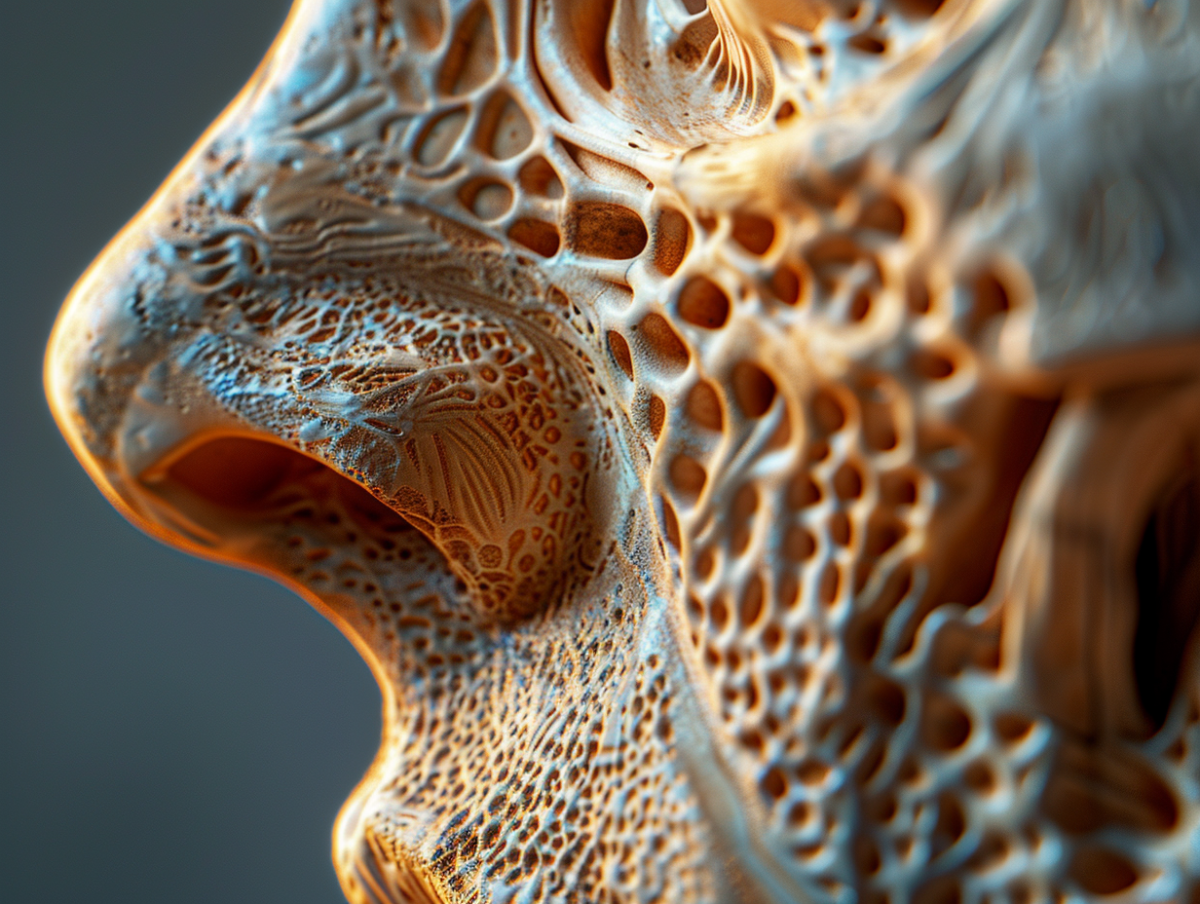
The nose, the central element of the face, holds subtleties that fascinate scientists and artists alike. Its complex structure, made up of cartilage, bones, and soft tissues, plays an undeniable aesthetic role while fulfilling vital functions such as breathing and olfaction. This facial prominence varies greatly from person to person, reflecting human genetic diversity. Plastic surgeons strive to understand its nuances to improve their techniques, while anthropologists use it as an indicator of ethnic origins. The nose is therefore an organ rich in information, both on an individual and collective level.
Anatomy and Functions of the Nose
At the heart of the facial mass, the nose stands as a sentinel, both guarding the air we breathe and serving as a watchtower for our emotions, expressed through its subtle changes in shape. Its structure consists of bones and cartilages, articulated in a complex architecture, encompassing the nasal pyramid and the nasal septum. The nasal cavities, essential passages for inhaled air, contribute to filtration, humidification, and warming before the air reaches the lungs. The sinuses, air-filled cavities, play a role in the resonance of our voice, as well as in reducing the weight of the skull.
The different types of noses, in their morphological variability, attest to the adaptation of the human species to varied environments. From the aquiline to the flat, each nasal shape has its own aesthetic and functional signature. The facial muscles, innervated by the facial nerve, are the architects of facial expressions, transforming the face into a living canvas of our moods. The mobility of the jaw, articulated with the skull, adds to this expressive dynamic, allowing for an almost infinite variety of expressions.
The complexity of the anatomy of the nose is also revealed in its contribution to facial expressions. The details of the nose add a touch of subtlety to the emotions conveyed, modulating the overall expression of the face. Thus, the nose, through its multiple facets, stands as a key player in the non-verbal narrative that each face tells, going beyond its sole respiratory function to become a vector of interpersonal communication.

The Nose and the Expression of Emotions
The human face, a complex tableau of reliefs and cavities, expresses emotions through its multiple components. The nose, a central element of this landscape, actively participates in mapping the feelings that pass through us. Facial expressions, these cascades of muscular movements, also draw their essence from the nasal pyramid, which, discreetly yet powerfully, alters the perception of a face in turmoil.
Researchers like Paul Ekman have demonstrated that our face is capable of manifesting nearly 10,000 expressions, with the nose playing its role in this extensive repertoire. The facial muscles, innervated by the facial nerve, orchestrate these expressions, with micro-expressions being brief and involuntary manifestations that often escape our conscious control. The transverse area of the nose contracts, for example, during a grimace of disgust or contempt, thus revealing an intense and often unexpected emotion.
The eyes and eyebrows are often cited as the dominant vectors of emotional expression, but the symphony of movements would not be complete without the contribution of the nose. The eyebrows, in their dance, can curve up and down, interacting with the nasal folds to create a visual wave that enhances the reading of an emotion. This subtle interaction is the result of a complex musculo-aponeurotic system that links each component of the face.
The mouth, surrounded by a multitude of muscle groups, collaborates with the nose to produce an infinite range of emotional shapes and nuances. Laughter, sadness, surprise—each of these emotions modifies the architecture of the nose and mouth, sketching on the face the inner story of our feelings. The technical analysis of these expressions, particularly in the context of aging, sheds light on the evolution of the aesthetic units of the face and their impact on our ability to communicate our emotions accurately.